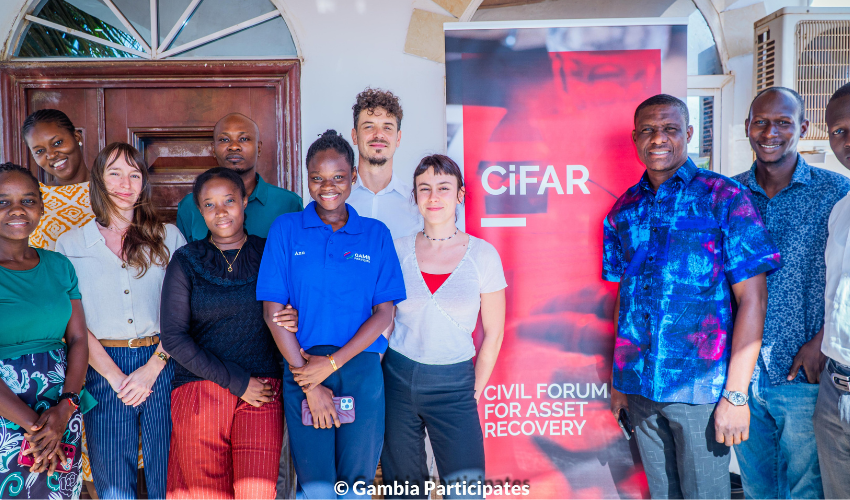
In early 2026, CiFAR launched a new project - Empowering Civil Society for Transparent and Inclusive Asset Recovery in West Africa. During two planning workshops in the Gambia and in Benin, we went through some of the main asset recovery cases across the continent, explored good practices for civil society engagement and planned activities for the coming months.
Corruption is not a victimless crime. Its costs go far beyond the money and property stolen. Corruption greatly undermines human dignity by depriving citizens of access to basic rights and services, including healthcare, education, justice, and economic opportunities. International and regional frameworks exist to combat corruption, and within them lies the potential for restorative justice by reshaping these processes to centre on human beings, particularly victims of corruption.
Hoy nos complace presentar seis evaluaciones de la aplicación nacional de la Posición Común Africana sobre Recuperación de Activos.
Aujourd'hui, nous avons le plaisir de lancer six évaluations de mise en œuvre nationale de la Position africaine commune sur le recouvrement des avoirs (CAPAR).
Today we are pleased to launch six assessments of national implementation of the Common African Position on Asset Recovery.
The CAPAR Civil Society Network, Civil Forum for Asset Recovery (CiFAR) and Transparency International, co-hosted a two-day workshop on the Common Africa Position on Asset Recovery (CAPAR) and Asset Recovery in Africa, held in Nairobi, Kenya on April 25-26, 2024. It brought together policymakers, regional bodies, and civil society organizations (CSOs) to engage in collaborative dialogue on enhancing asset recovery efforts in Africa.
On the 25th and 26th April 2024, regional bodies, parliamentary networks, asset recovery interagency networks, and civil society representatives will gather in Nairobi, Kenya for the Regional workshop on the Common Africa Position on Asset Recovery (CAPAR) and Asset Recovery in Africa.
Illicit financial flows (IFFs) are a significant obstacle to Africa’s development, as they drain essential resources. To confront this challenge, the African Union took concrete steps, starting with the adoption of the Special Declaration on Illicit Financial Flows in January 2015.
In the past 20 years, African governments have made considerable progress to recover stolen assets as a tool to combat Illicit Financial Flows and contribute to sustainable development. Asset recovery has gained attention among governments, the media and citizens. Several governments have introduced new asset recovery laws and created institutions in charge of recovering or managing stolen assets. This has led to an increase in recovered assets, both domestically and internationally. However, legislative and institutional frameworks, as well as efforts in international cooperation are still insufficient.
Page 1 of 2
Next →